Remembering a picture and naming it are separate steps
You may recognise an object immediately yet need a moment to say its name in another language. A picture-recall game adds a further question: can you keep the object in mind after it is hidden? It helps to notice which part of that sequence is difficult instead of treating every hesitation as the same problem.
In Mumble Aloud, select a familiar answer language and an approachable stage. The current release accepts English, Czech and Italian spoken answers; the interface is in English. Begin with material you recognise so you can focus on the spoken answer.
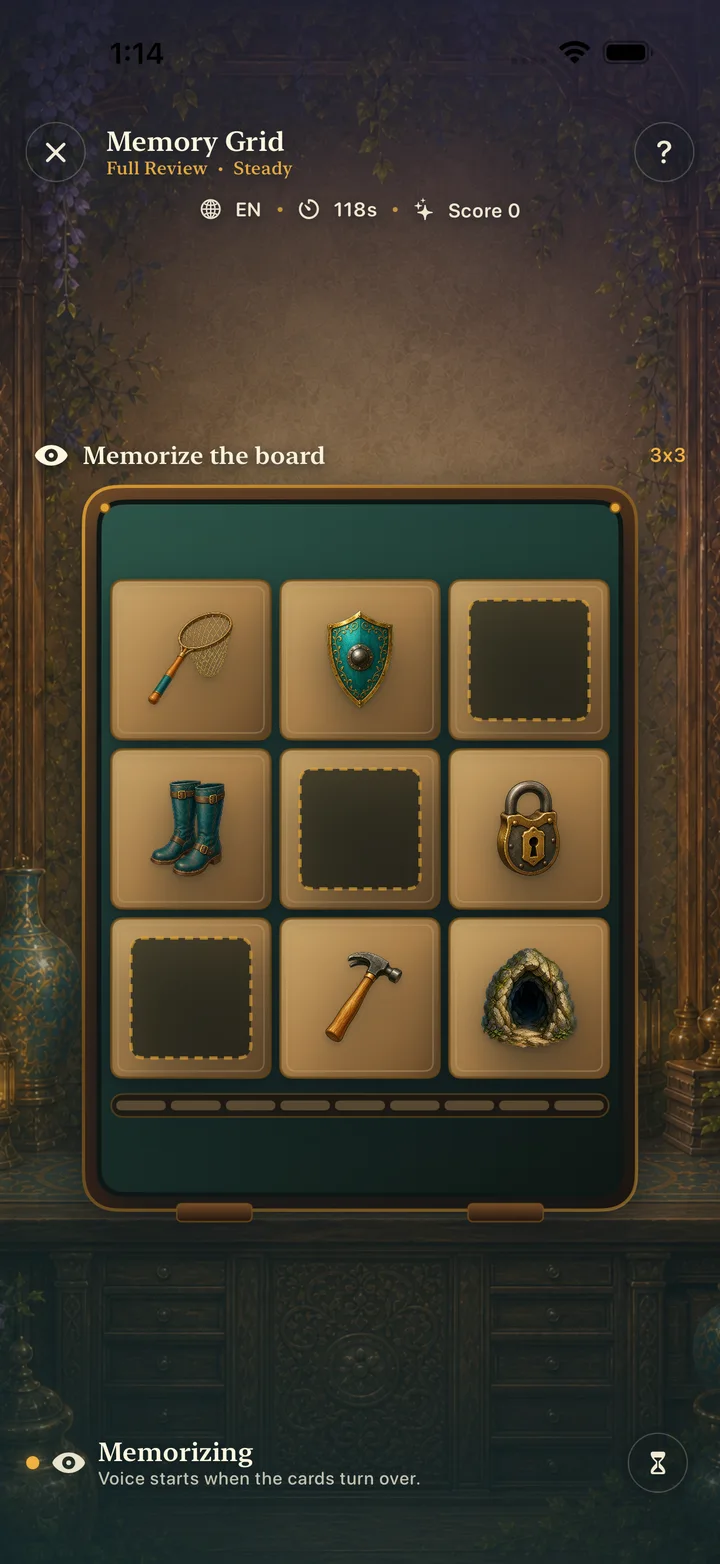
Memory Grid: hold the picture in mind
Memory Grid shows pictures and then hides them. Your task is to recall what was shown and say the answer. The visual clue is no longer doing all the work at the moment you speak.
For your first round, look carefully at the visible cards. Connect each picture with its name before it disappears. When prompted, retrieve the picture first, then the word. After the round, notice whether you forgot the card itself or remembered the image but could not quickly retrieve its name.
Match Deck: find the relationship
Match Deck asks you to connect a prompt picture with an answer card. This puts the emphasis on interpreting the relationship and then speaking the answer. Choose this when you want the clue-solving part to be more prominent than remembering a hidden set.
These are game tasks with accepted answers. They are not open-ended conversation prompts. If you want to discuss an image in full sentences, do that afterwards with another person or in your wider language practice.
A repeatable three-step practice idea
- Before play: choose one small stage and familiar answers. Say the words at your own pace.
- During play: let the clue lead you to the answer. Keep other conversation quiet while the microphone listens.
- After play: pick one hesitation and identify its cause: the picture, the memory, the word, or recognition by the phone.
If the picture is unfamiliar, learn what it represents first. If the word is unfamiliar, look it up in your usual learning resource. If you know the word but the game misses it, check the selected language and speech permissions in Mumble Aloud Support.
Choose a game or your own picture deck
Mumble Aloud supplies its own puzzles, which is useful when you want prepared play. A custom flashcard collection is a different choice when you need exact vocabulary from your own life. Our Anki comparison explains that tradeoff, including audio-card options.
For family play, take turns and let the current player finish before offering the word. For solo practice, keep the session small enough that you can notice what happened. The useful outcome is another opportunity to retrieve a word, without treating a game score as a measure of fluency.
Try Mumble Aloud. See the game and its screenshots, or open its App Store page.
The current App Store release is free, with no in-app purchases.