The key difference is who chooses the material
Anki is a flashcard system with custom decks, media support and scheduled review. AnkiMobile is its official iPhone and iPad app. Here, “Anki” refers to that ecosystem rather than unrelated apps with similar names.
In Mumble Aloud, the released game supplies the puzzle content and accepted answers. You choose a game, language, stage and intensity. You are not designing a personal deck: you are playing a number, picture, memory or sound challenge.
| What matters | Mumble Aloud | Anki / AnkiMobile |
|---|---|---|
| Material | Four supplied puzzle types | Your own or shared flashcard decks |
| Answer loop | Speak a recognised answer to the clue | Recall, reveal the card, and rate your recall |
| Review organisation | Choose the stage you want to play | Schedule future card reviews |
| Audio possibilities | Speech recognition and Sound Source clues | Audio cards and an AnkiMobile voice-recording tool |
When Mumble Aloud is the convenient choice
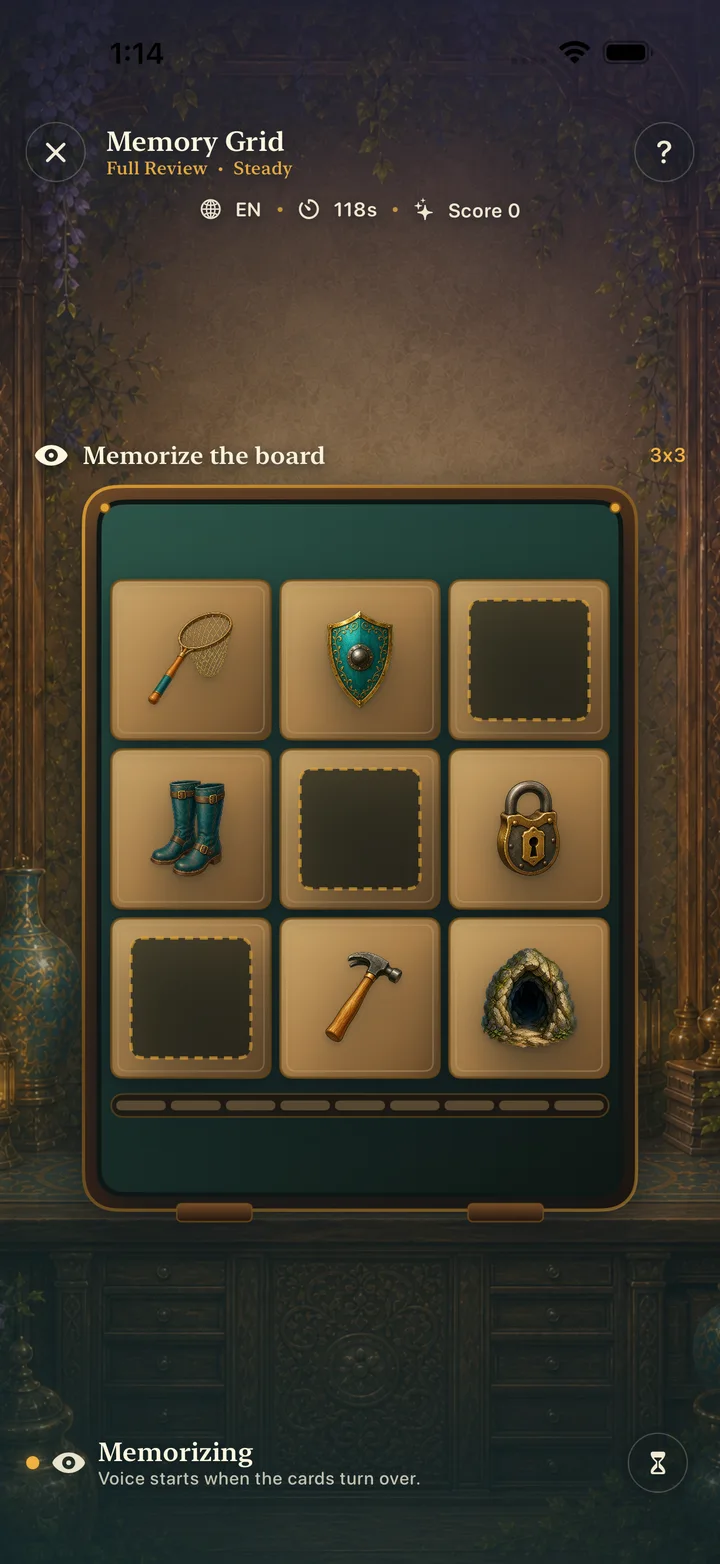
If you want to open a game and solve a prepared clue, Mumble Aloud has the content ready. A Memory Grid round asks you to hold pictures in mind and speak what was hidden. A Sound Source round asks you to retrieve a name from an audio clue. Those situations make recalling the word part of the game action.
The current release supports English, Czech and Italian answers with English menus. It is free, with no in-app purchases or account. That can be a comfortable starting point when you want a short session using familiar material and do not need a custom vocabulary list.
When Anki is the more useful tool
Choose Anki when the exact material matters: words from your own book, course or work, for example. Its review workflow lets you reveal an answer and rate how well you remembered it. Scheduling is central to that routine; Mumble Aloud does not provide an equivalent personal spaced-repetition deck.
Flashcards do not have to be silent or text-only. You can say an answer before revealing it, and Anki supports sound and pictures. AnkiMobile’s Record Voice tool can temporarily record your voice for comparison with card audio. It would be misleading to claim that only a speaking game can support spoken practice.
Try the same decision on a real study day
If today’s task is to revisit fifteen words from a lesson, use a deck containing those words. If today’s aim is simply to enjoy retrieving familiar answers aloud, choose a Mumble Aloud puzzle. If you use both, keep their jobs clear: personal material in the deck, prepared game challenges in Mumble Aloud.
A speech-recognition match in Mumble Aloud and a recall rating in Anki are different kinds of feedback. Neither comparison here establishes which routine produces better learning for you.
Sources and perspective
Exricel Studios makes Mumble Aloud. We checked the current public game and the linked official Anki site and manuals on 8 September 2026. Check the App Store for current AnkiMobile purchase terms. We have not benchmarked the two products.
Try Mumble Aloud. See the game and its screenshots, or open its App Store page.
The current App Store release is free, with no in-app purchases.