Choose Mumble Aloud for short puzzles where remembering and saying the answer is the next move. Choose Duolingo when you want a course that introduces and revisits language through several kinds of exercise.
Both include speaking; the task differs
Duolingo describes courses combining reading, writing, listening and speaking. Its speaking activities include repeating words, answering aloud and short dialogues. Available activities vary with the course and product experience.
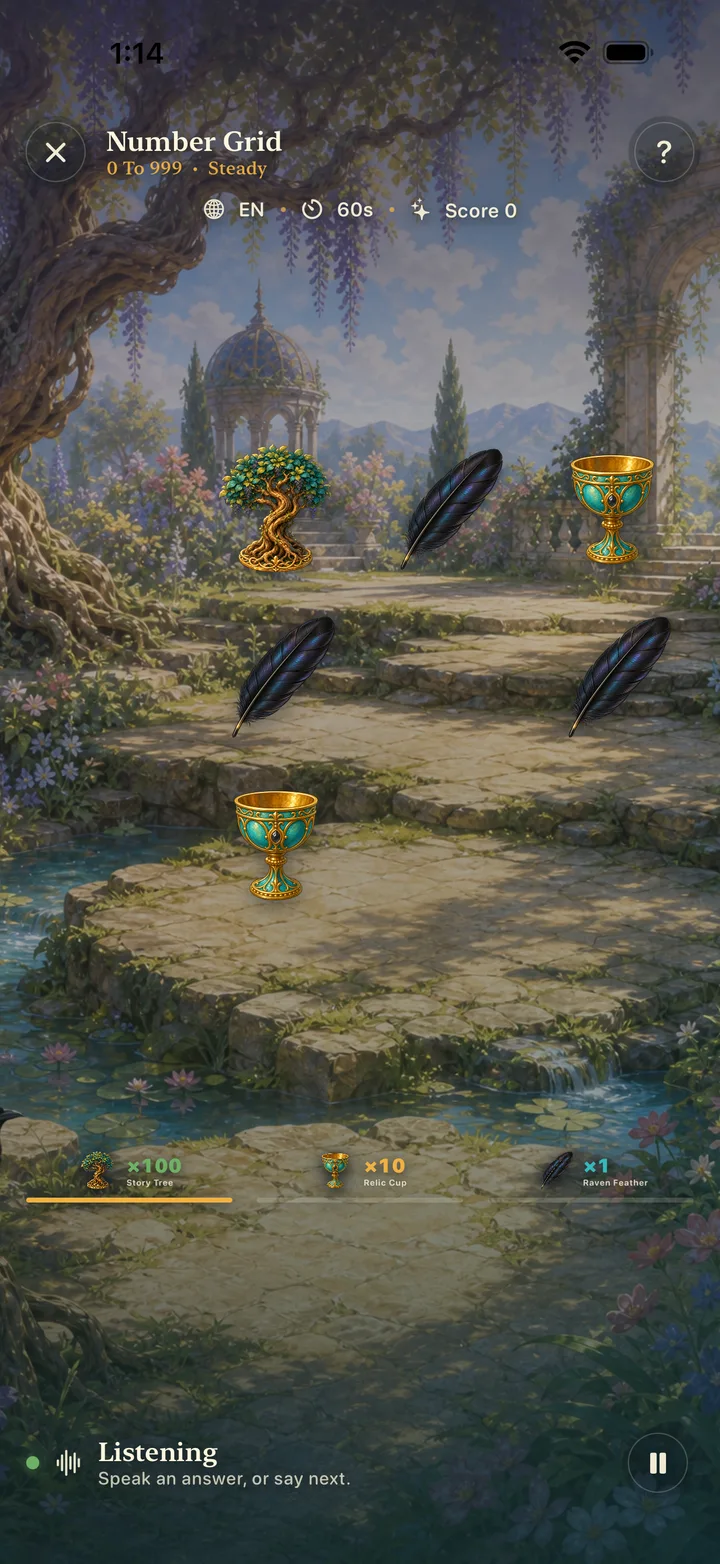
Mumble Aloud starts from a puzzle clue. In Number Grid, you count quantities and speak the total. In Memory Grid, you recall a hidden picture. Sound Source begins with something you hear; Match Deck asks you to find a picture relationship. Speech recognition accepts the answer so the round can continue.
| Your question | Mumble Aloud | Duolingo |
|---|---|---|
| What is the session built around? | A number, memory, sound or picture puzzle | Language lessons and practice |
| Where do answers come from? | Recall a word or number from the clue | Respond to the lesson’s exercise |
| Language scope | English, Czech or Italian spoken answers; English menus | A wider course catalogue; inspect your language pair |
| A strong fit | Playing with words you already recognise | Following a broader study path |
Where Mumble Aloud has a useful edge
The puzzle supplies a reason to retrieve a word beyond reading it from the screen. Consider a Number Grid with one object worth 100, two worth 10 and three worth 1: the answer is 123. The player has to resolve the quantity before saying it. That particular clue-to-answer loop is the reason to choose this game.
The current release is free, has no in-app purchases, and requires no account. You can select an approachable stage and intensity, then return to a familiar puzzle. This can suit adults practising spoken recall or families taking turns in a language they know.
Where Duolingo is a stronger choice
If you want to learn a language from the beginning, expand into sentences, or follow an ongoing course, Mumble Aloud’s small collection is not a replacement for that scope. Duolingo is already playful and already includes speaking; the distinction is the structure of the activity, not whether one app “has games”.
Duolingo also describes free focused practice in its Practice tab, including speaking and listening. Its speaking tools include more than repetition, so choose Mumble Aloud for its particular puzzle format. Check the options available in your course when deciding where to practise.
A practical way to use both
Learn a small set of words through your regular study, then choose a Mumble Aloud stage using familiar answers. After the round, take one word you hesitated over and use it in a sentence. The game gives you another recall opportunity; your wider practice supplies context and conversation.
Mumble Aloud uses Apple’s speech recognition. Permissions, language and audio conditions can affect a result. It does not provide a detailed pronunciation score or conversation assessment.
Sources and perspective
Written by Exricel Studios, the maker of Mumble Aloud. Features checked on 8 September 2026 against our public release and the linked Duolingo explanations. This comparison does not measure learning effectiveness or compare speech-recognition accuracy.
Try Mumble Aloud. See the game and its screenshots, or open its App Store page.
The current App Store release is free, with no in-app purchases.